

NACIS 2020
Bike Mapping: Process and insights riding every single street in Huntsville
Presenters: David Nuttall and Ned Drummond
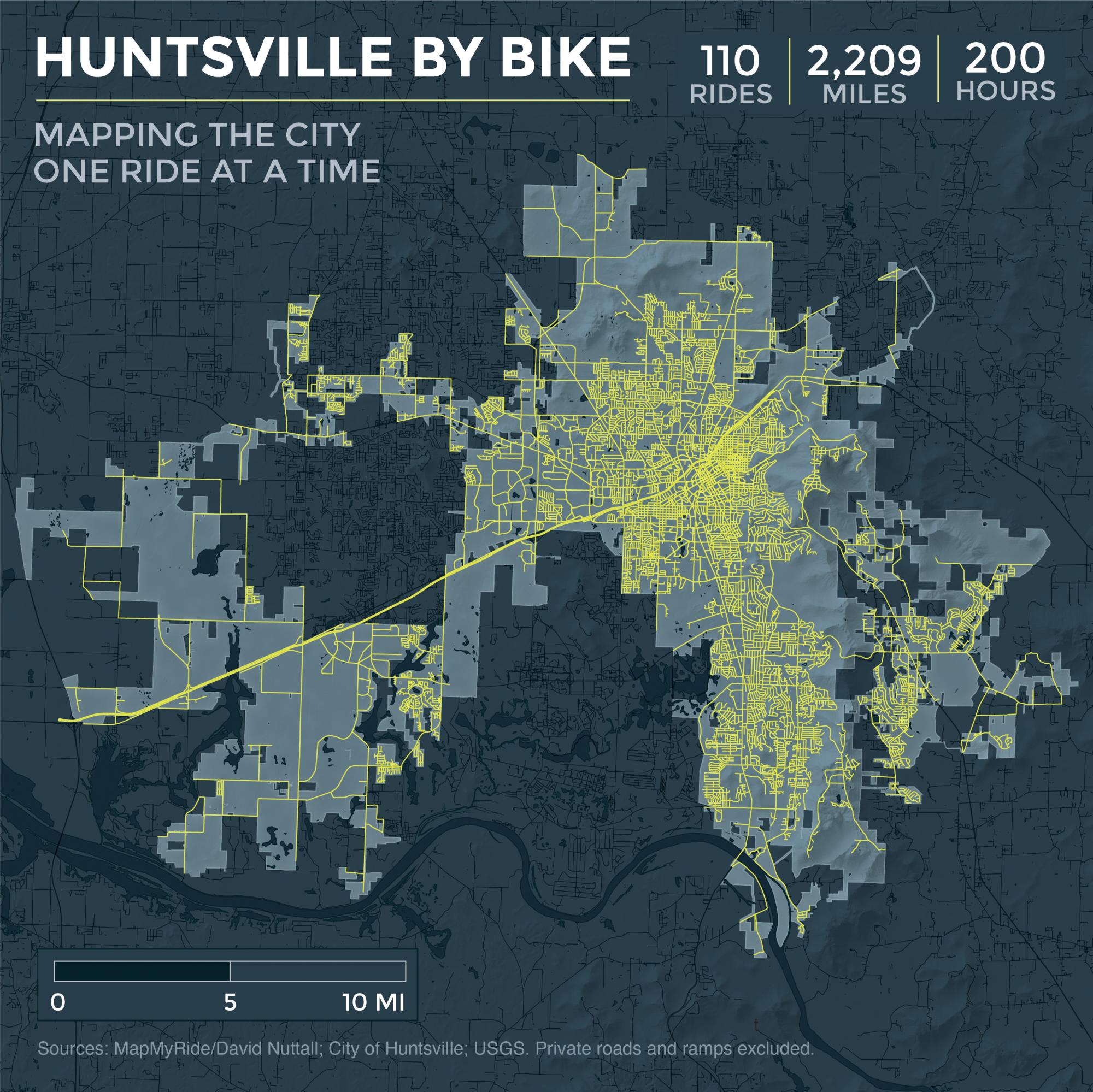
Mapping the City - One Ride at a Time
Have you ever thought of seeing your entire city, every single street, by bike?
This is my "quest" to ride every single street withing the city limits of Huntsville, Alabama during 2019 and 2020. And to map the progress and share the observations.
Here are the final maps, created in collaboration with my cartographer/designer friend Ned Drummond. This includes the chronological animated map of all rides.
Since the quest ended, the city has both built new streets and annexed additional land (how dare they) so I constantly keep up with the changes and cycle any new streets to keep my "completion rate" up!

A rough density/frequency map showing how inefficient a lot of the rides were, basically starting from my house each time in 2019.


Bike difficulty mapping
Classifying every street in the city by how hard it is to ride

Huntsville Streets
Every single street (by block/segment) rated by difficulty to ride a bike
Overall Scope
The project scope is to add color-coding to each street segment to classify the degree of difficulty to ride a normal pedal-powered bike. These same criteria will overlap with e-bikes, except for slope-related classifications (when not on a main road). The primary concept is to produce a visual indicator of the difficulty of city streets and the level of confidence and ability needed to safely ride on any segment of roadway.
The secondary concept is to clearly indicate the level of ability needed to cycle anywhere beyond a neighborhood, to show how bike riding between different destinations and areas of the city requires a certain level of ability and confidence.
Ideally this data can be incorporated into a future bike routing app to allow cyclists to have a "confidence/ability profife" and get directions that suit their own comfort level.
This analysis is when riding on a road, including bike lanes, but does not include alleyways, greenways, and dedicated bike paths separate from the road.
Colors
The colors classifications are:
What do these mean in reality?
Green – beginner
o Anyone could ride once they are moderately comfortable on a bike. These segments will be essentially flat and have limited side streets/entrances and be wide enough for vehicles to pass easily. The volume of motorized traffic is low.
o Skill level: basic – but confident enough to be on a street.
Blue – Intermediate
o More skilled cyclist, comfortable on a bike. These segments will be mostly flat and have few side streets/entrances and be wide enough for vehicles to pass easily. The volume of motorized traffic is low to moderate.
o Skill level: reasonable, good hand signals – confident on bike and aware of their surroundings.
Red – Advanced
o Skilled cyclist, very comfortable on a bike. These segments will not be flat and/or have side streets/entrances, including businesses. The volume of motorized traffic is moderate to high and the roadways may be narrower without turn lanes.
o Skill level: good, ability to manage hills – confident on bike, ability to handle traffic and very aware of their surroundings.
Black – Expert
o Very skilled cyclist, extremely comfortable on a bike. These are main roads with high volume and high traffic speed or are very steep. Segments will not be flat and/or have multiple side streets/entrances, including businesses/industry. The volume of motorized traffic is high to very high and these are considered dangerous roads to cycle on.
o Skill level: very high, ability to adapt to surrounding traffic and withstand fast moving larger vehicles passing by.
Static version of the completed map, showing how large/sprawled Huntsville is (about 220 sq miles) and the interesting shape the city limits make.
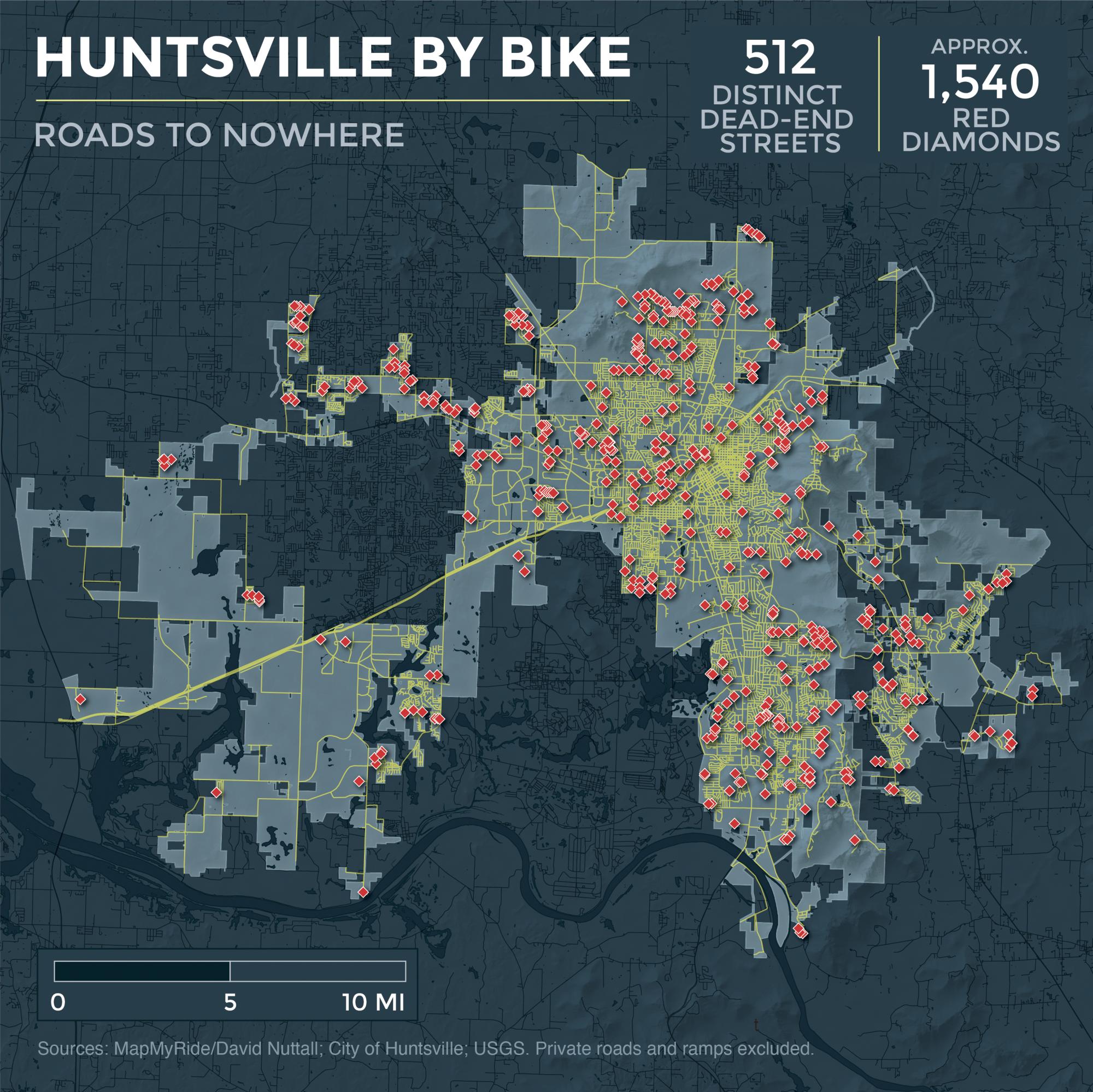
One of the main observations of the ride was discovering the number of streets that were dead end unfinished roads. Not cul-de-sacs or planned to end, but roads intended to continue, but were not finished. So many missing links, often ridiculously short, that could make the city so much more connected.
Active Towns podcast interview
Observations from riding every single street.


